
Islam and genital mutilation
Primary tabs
http://smoothstone.blogspot.com/2006/12/islam-and-female-genital-mutilat...
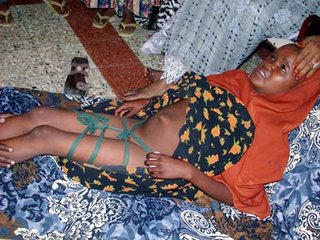
Fatima's scream is as blood-curdling as it is heart-wrenching. The little girl, who looks to be about eight years old, screams in a panic, initially in fear and then because she is unable to bear the pain she is experiencing. She is lying on the floor of a dirty hut somewhere in the Ethiopian desert. Her body is contorted with pain as she screams, cries and finally lies there whimpering. Her new, green floral dress is soaked in blood. Two men and her mother press the delicate child against the floor and pull apart her thin little legs.
An old woman crouches in front of Fatima, holding a shiny razor blade and a thick, threaded darning needle. Today is the day Fatima will become a woman, a decent woman.
The purpose of the thick darning needle is to lift the lips of the vulva to facilitate cutting them off. The old woman moves the razor blade into position. First she slices off the small lips of the vulva and then the clitoris. There is blood everywhere. The girl arches her small, sweat-soaked body. The old woman repeatedly pours a milky liquid onto the wound to prevent infection. Then the grandmother comes into the hut, pokes at the wound and tells the old woman to make a deeper cut. The process starts all over again. Fatima's screams become almost unbearable. If the sight of this girl under female circumcision is so difficult to bear, how can she possibly stand the pain?
Finally the deed is done. The wound is sewn shut with thorns, leaving only a tiny opening. A straw is inserted into the small opening to prevent it from closing. Then Fatima's legs are tied together with a rope to allow the wound to heal. She will lie in bed, her legs tied together in this fashion, for several weeks.
The old woman completes her barbaric task with a slap on her subject's behind. Fatima is now a woman.
About 6,000 girls fall victim to genital mutilation every day, or about 2 million a year. The World Health Organization (WHO) estimates that between 100 and 140 million women worldwide are circumcised. Most circumcised women live in 28 African countries, as well as in Asia and the Middle East. According to the United Nations Children's Fund (UNICEF), at least 90 percent of all women are circumcised in developing countries like Ethiopia, Sudan, Djibouti, Somalia and Sierra Leone, while almost no women are circumcised in Iraq, Iran and Saudi Arabia.
WHO distinguishes among four types of genital mutilation:
Type I, or "clitorectomy": Excision of the skin surrounding the clitoris with or without excision of part or all of the clitoris
Type II, or "excision": Removal of the entire clitoris and part or all of the labia minora
Type III, or "infibulation": Removal of part or all of the external genitalia and stitching together of the vaginal orifice, leaving only a small opening
Type IV: Various other practices, including pricking, piercing, incision and tearing of the clitoris.
One out of every three girls dies as a result of infibulation, also known as pharaonic mutilation.
Women have been circumcised for thousands of years, and the custom has become deeply ingrained in human thought. Tradition demands that women be circumcised, and it is often the women themselves who wish to continue this ritual, partly to prevent sexual desire in girls. Indeed, an uncircumcised girl is considered worthless on the marriage market in many places because she is perceived as being "impure" and "loose."
Although circumcision is often justified for supposedly religious reasons, there is no religious justification for the practice in either Christianity or Islam.
Sharp condemnation by religious and moral leaders is needed to ban this horrific practice. But movement does appear to be afoot -- at least if an event that took place in Cairo two weeks ago is any indication. It bordered on a minor revolution.
Muslim scholars and academics from Germany, Africa and the Middle East spent two days discussing female genital mutilation. The goal of the conference was to declare this form of circumcision to be incompatible with the ethics of Islam as a global religion.
It was a German who organized and funded the conference. In 2000 Rüdiger Nehberg, 71, a man known for adventurous exploits that have included crossing the Atlantic in a pedal boat, founded Target, a human rights organization dedicated to fighting female genital mutilation. Since then Nehberg, accompanied by his life partner Annette Weber, has been traveling throughout Africa with his video camera, documenting the inhuman practice and attempting to win over political and religious leaders for his cause. Wherever he goes, Nehberg says: "This custom can only be brought to an end with the power of Islam." In organizing the conference, which was held at Cairo's Al-Azhar University under the patronage of Egyptian Grand Mufti Ali Jumaa, Nehberg has come one step closer to his goal.
Many important Muslim scholars attended the event. The Egyptian minister for religious charities, Mahmoud Hamdi Saksuk, condemned the practice, as did the Grand Sheikh of Al-Azhar University, Mohammed Sayyid Tantawi. Even the renowned and notorious Egyptian religious scholar and journalist Yusuf al-Qaradawi, who enjoys great popularity in the Middle East as a result of his commentary on the Aljazeera television network, attended the Cairo conference.
Qaradawi did full justice to his reputation as a hardliner by initially criticizing the fact that the conference was paid for by a foreign institution, and not the practice of mutilation. He also complained that the title, "The Prohibition of Violation of the Female Body through Circumcision" was biased and presumptuous.
But after plenty of hemming and hawing, even Qaradawi managed to agree that the Koran states that it is forbidden to mutilate God's creation. "We are on the side of those who ban this practice," he said, but added that doctors ought to have the last word.
This wasn't enough for women's rights activists. Mushira Chattab, the Egyptian first lady's special ambassador and chairwoman of the National Council for Childhood and Motherhood, called upon the legal scholars at the meeting to take a clear position against female circumcision. Then she turned to Qaradawi and said: "You should not leave it up to doctors to condemn this practice."
Every doctor at the conference agreed that there is no medical justification for female genital mutilation. Heribert Kentenich, physician-in-chief of the women's clinic at the DRK Hospitals in Berlin expressed a "complete lack of understanding" for the fact that 75 percent of circumcisions are now performed by doctors in Egypt. "I find it almost more horrifying that doctors are enriching themselves by doing this," he added. The drop in the estimated incidents of female circumcision has dropped significantly -- some believe as much as from 97 percent to approximately 50 percent -- but it is impossible to obtain precise figures. Even at 50 percent, that would still represent roughly 400,000 girls a year. Kentenich believes that the "medicalization of female genital mutilation makes it seem more acceptable."
The direct consequences include hemorrhaging, as well as severe pain and anxiety that can lead to trauma. Besides, the practice can also cause infections in the urinary tract, the uterus, the fallopian tube and the ovaries. Other consequences such as tetanus infections, gangrene and blood poisoning can be fatal. Besides, women who are subjected to pharaonic mutilation experience increased pain during menstruation, when blood accumulates in the vagina because the opening is too small to permit normal flow. Mutilated women are also at greater risk for becoming infected with HIV.
Intercourse is painful for circumcised women. To be able to penetrate, men must often force themselves into their wives' vaginas. Those whose penises are incapable of doing the job use a knife to enlarge the opening.
Circumcised women can face complications during pregnancy, and both the mother and child are at greater risk of dying in childbirth.
There is no religious justification for this practice. All three major monotheistic world religions define man as a perfect creation of the Almighty, and condemn doing any harm to God's creation. In Sura 95, Verse 4, the Koran states: "We have created man in our most perfect image." Besides, in Islam men and women are meant to experience sexual fulfillment, and it is considered the husband's matrimonial duty to satisfy his wife -- a near impossible task when a woman is circumcised.
Although the conference's attendees were generally in agreement over these facts, men repeatedly insisted on defending circumcision as an established custom. "Our women have been circumcised for thousands of years, and they have never complained," said an agitated elderly man in the audience. The conference, he said, was a Western conspiracy, and showing pictures of circumcisions was a crime.
But the academics and scholars in attendance declared genital circumcision to be a deplorable custom without any basis in religious texts. They called upon the parliaments in the countries where the practice is common to pass laws making genital mutilation a crime.
The Grand Mufti of Egypt signed the resolution the next day. Ali Jumaa declared that he firmly believed that the fight against this terrible custom would succeed. Muslims base much of their behavior on legal opinions issued by religious scholars.
For Rüdiger Nehberg, the adventurer on a crusade for women, the conference represented the fulfillment of a dream. He now plans to "print a small book containing the recommendation and the scholars' comments and distribute 4 million copies worldwide."
Click here to view a map of some of the areas where Female Genital Mutilation (FGM) is practised.
Now if Muslim "scholars" can all agree that killing Jews and Christians is also a terrible custom, then I'll have some reason to review Islam as a religion, rather than as a political movement.


